Mémoire
Costs and trajectories: OpenAI's environmental footprint, short and long term
What it
really costs
This dissertation looks at the environmental footprint of OpenAI. It separates two things that are often confused: what this footprint costs today, and where it is heading if the current trend continues. The starting point is a gap. Artificial intelligence is almost always presented as an immaterial technology, when in fact it rests on a very real physical infrastructure that consumes large and growing amounts of energy, water and raw materials.
I rely on papers from academic conferences and on institutional reports to document these costs, grouped under three axes: the direct consumption of energy and water tied to large language models, the mining and critical-material supply chains behind the infrastructure, and the long-term growth of these impacts, set against planetary boundaries.
It is also a research-creation project. Alongside the text, I built Heritage, a virtual reality game. Drawing on artists like Joana Moll, Kate Crawford and Vladan Joler, I defend one simple idea: artistic form can make us feel what academic research, on its own, does not always manage to convey.
Three parts
AI as a material reality
What the immaterial hides: infrastructure, energy, extraction, and virtual reality as a space for awareness.
What OpenAI really consumes
The energy and water each query devours, the mining behind the infrastructure, and trajectories that run away.
Heritage, inhabiting the invisible
Building a playable data center, what the mechanics reveal that text cannot, and the limits of the piece.
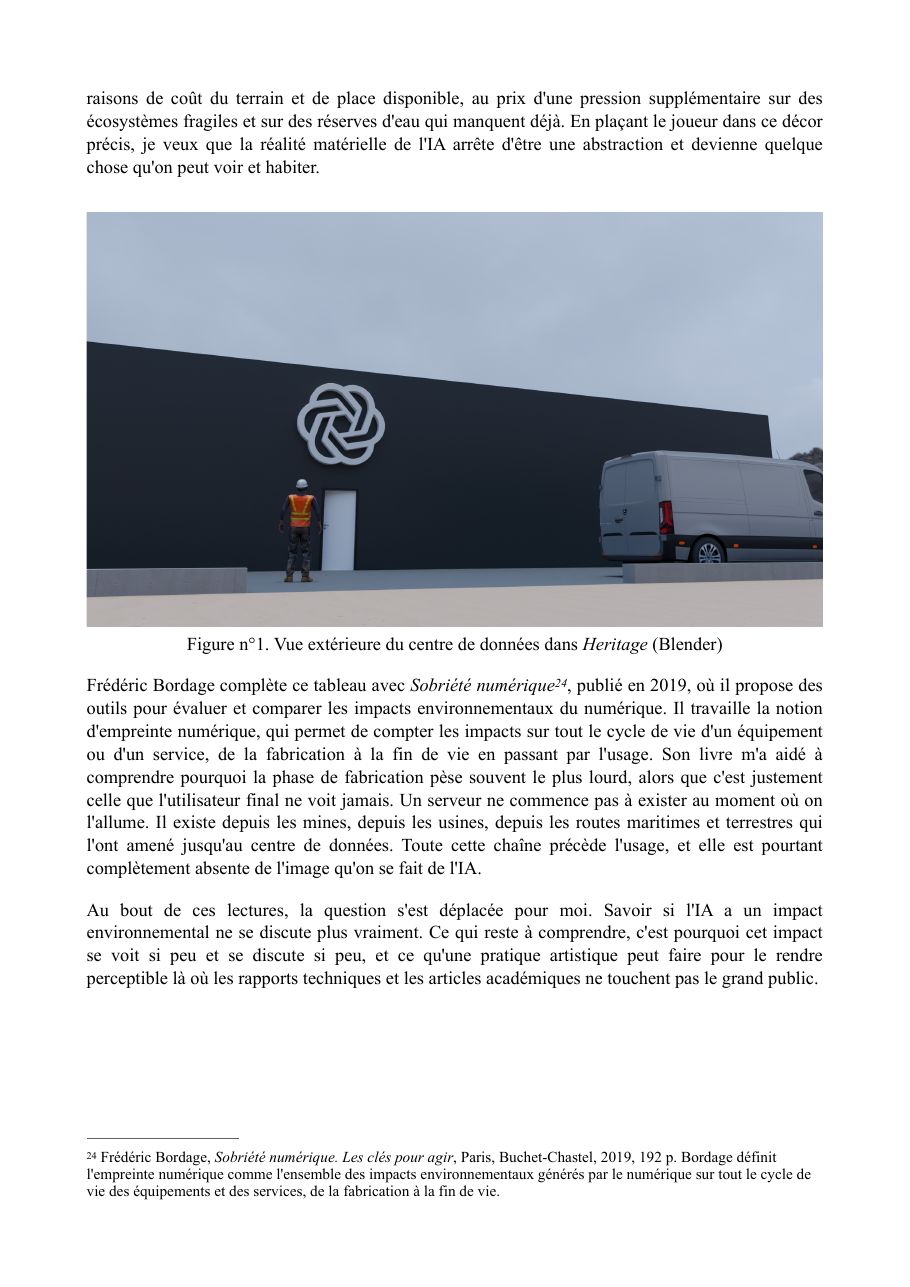
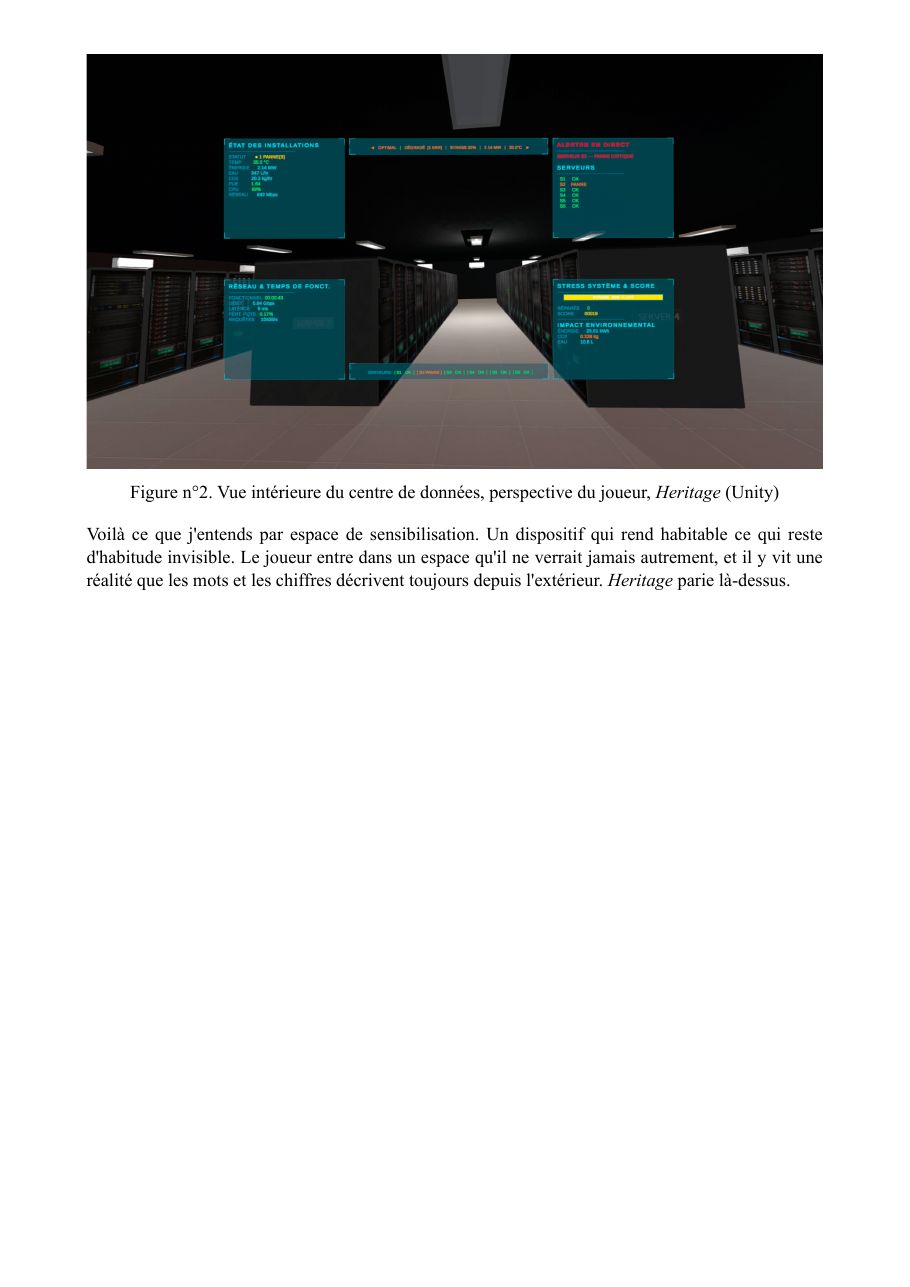
A first-person VR game: you play a technician inside a data center dropped in the middle of a desert, keeping the system running while an interface shows you, in real time, what it consumes. Heritage does not try to prove a point, it tries to make a situation real.
Read the thesis